FALL IS PRIME SEASON FOR MICE IN KANSAS CITY
If you’re noticing mouse activity in your home right now, you’re not alone — and the timing makes sense. As temperatures drop in late summer and early fall, mice begin actively searching for warm shelter, food, and water. Kansas City homes, particularly older ones in neighborhoods like Brookside, Waldo, Westport, and the surrounding KC metro, offer plenty of entry points: gaps around pipes, cracks in foundations, aging door seals, and utility penetrations that are easy to overlook.
A mouse can squeeze through a gap the size of a dime. Once one finds its way in, others follow quickly. Mice reproduce rapidly — a single female can produce 5 to 10 litters per year. An infestation that starts with a few mice in September can become a serious problem by November if it isn’t addressed.
The right time to act is when you first notice signs — not after the population has established itself.
SIGNS YOU MAY HAVE MICE IN YOUR KANSAS CITY HOME
Mice are nocturnal and secretive, so you rarely see them directly — especially in the early stages of an infestation. Here’s what to look for:
-
Droppings — Small, dark, rod-shaped droppings (about the size of a grain of rice) along baseboards, in cabinets, behind appliances, or in pantry areas
-
Gnaw marks — Chewed food packaging, baseboards, wiring, or structural materials
-
Scratching or scurrying sounds — Particularly at night, coming from inside walls, ceilings, or under floors
-
Nesting material — Shredded paper, insulation, fabric, or other soft materials gathered in secluded areas
-
Grease marks — Dark smear marks along walls and baseboards from mice repeatedly traveling the same routes
-
Odor — A musky odor in enclosed spaces like cabinets, closets, or utility rooms
If you notice any of these signs, call us. The sooner we can inspect, the simpler and less expensive the treatment.
5 Warning Signs of Rodents in Winter
OUR MICE AND RAT CONTROL PROCESS
Gunter’s rodent control program combines a thorough inspection with strategic bait station placement — the most effective and reliable approach for eliminating mice and rats in residential settings.
Step 1: Full Inspection
Our technician inspects your home to confirm rodent activity, identify the type of rodent (mice vs. rats behave differently and are treated differently), and locate the primary harborage and travel routes. This step drives everything that follows — placing bait without understanding where rodents are active is guesswork.
During the inspection we examine:
-
Interior areas including kitchens, utility rooms, basements, and crawl spaces
-
Garage and attached structures
-
Attic access points if applicable
-
Exterior perimeter for signs of activity and potential entry points
Step 2: Bait Station Placement
We place tamper-resistant bait stations in targeted locations along active rodent travel routes — typically along walls, behind appliances, in utility spaces, and in other areas where activity has been confirmed. Bait stations are child- and pet-resistant and are placed in areas inaccessible to children and pets where possible.
Step 3: Ongoing Monitoring (Quarterly Plans) or Optional Follow-Up (One-Time Service)
For customers on a quarterly rodent control plan — whether added to Residential Plus or as a standalone service — we return every quarter to inspect for new activity, refill bait stations, and replace stations as needed. Free callbacks are included between visits.
For one-time service customers, the initial visit is designed to address the active infestation. If you’d like us to return within 90 days to re-inspect and refill stations as a preventative measure, we can do so for $175 upon request.
Mice vs. Rats: What’s More Common in Kansas City?
In the Kansas City metro, mice — specifically the house mouse — are by far the more common residential pest. They’re smaller, more adaptable, and can enter through gaps that rats can’t. House mice are the most likely culprit if you’re hearing light scratching in walls, finding small droppings in kitchen cabinets, or noticing chewed food packaging.
Norway rats (also called brown rats or sewer rats) are less common in residential settings but do occur — particularly near older sewer infrastructure, commercial districts, and properties near waterways. Rats are larger, more cautious, and tend to burrow rather than nest in walls. They require a different baiting approach and station placement.
Our technicians are trained to identify which rodent you’re dealing with during the inspection and adjust the treatment plan accordingly. If you’re not sure what you have, that’s exactly what the inspection is for.
Why Professional Mice Control Beats DIY
Hardware store snap traps and store-bought bait boxes can catch individual mice — but they rarely eliminate an infestation. Here’s why a professional treatment is more effective:
Strategic placement matters. Mice follow consistent travel routes along walls and baseboards. Randomly placed traps miss most of the activity. Our technicians place bait stations where mice actually travel, based on on experience and what we observe during the inspection.
Population size is almost always underestimated. If you’re seeing one mouse, there are almost certainly more. By the time signs are visible, the population is usually larger than homeowners expect.
Bait stations are more effective than snap traps for ongoing control. Especially for Residential Plus customers who want ongoing protection — bait stations allow for continuous monitoring and re-baiting as part of your regular service.
Professional-grade products. The bait formulations available to licensed applicators are more effective than what’s available over the counter, and they’re deployed in tamper-resistant stations that are safer around children and pets.
Rodent Control Pricing in Kansas City
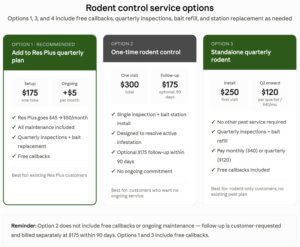
Option 1 — Add to Your Residential Plus Quarterly Plan (Recommended)
$175 one-time setup fee. If you’re already on our Residential Plus quarterly pest control plan, adding rodent control is the simplest and most cost-effective path. We charge a one-time $175 setup fee to inspect and place bait stations — from that point forward, quarterly inspections, bait refill, and station replacement are included as part of your plan for just $5 more per month (your Residential Plus goes from $45 to $50/month). Free callbacks included.
Option 2 — One-Time Rodent Control
$300. Our one-time service includes a full inspection and strategic bait station placement designed to address the active infestation in a single visit. If you’d like us to return within 90 days to re-inspect and refill stations as a preventative measure, we can do so for $175 upon request. No ongoing commitment required.
Option 3 — Quarterly Rodent Control
$250 to install, then $120 per quarter. If you want ongoing rodent protection without a full pest control plan, our standalone quarterly rodent service provides just that. After the initial $250 inspection and bait station installation, quarterly visits to inspect, refill, and replace stations as needed are $120 per quarter — or $40 per month if you prefer monthly billing. Free callbacks included between visits.
Commercial rodent control is also available. Pricing for commercial properties is customized based on the size of the facility, type of activity, and service frequency. Call 816-523-0777 to speak with our commercial pest control team.
Why Choose Gunter for Mice and Rat Control in Kansas City?
Gunter Pest & Lawn has been serving Kansas City since 1950 — 76 years and four generations of the Gunter family. Rodent control is part of our core residential pest management program, and our technicians have handled more mouse and rat situations in the KC metro than most companies in the area.
Licensed technicians. All Gunter technicians are registered pesticide applicators. We also have a certified entomologist on staff — a credential that’s uncommon in the Kansas City pest control market.
Thorough inspection first. We don’t skip straight to bait placement. Understanding where rodents are active and what’s attracting them to your home drives better results.
Honest, no-pressure service. We’ve built our reputation over 76 years on straightforward advice. If you have a minor mouse issue that can be resolved with a basic trap, we’ll tell you. If you have an infestation that needs professional treatment, we’ll tell you that too.
Flexible service options. Whether you want to add rodent control to your existing Residential Plus plan for just $5 more a month, handle a one-time issue with a single visit, or sign up for standalone quarterly coverage — we have an option that fits your situation.
Rodent and Mice Control Across the Kansas City Metro
We provide mouse and rat control services throughout the greater Kansas City area, including:
-
Kansas City, MO
-
Overland Park, KS
-
Leawood, KS
-
Prairie Village, KS
-
Lenexa, KS
-
Olathe, KS
-
Shawnee, KS
-
Independence, MO
-
Lee’s Summit, MO
-
Liberty, MO
-
Blue Springs, MO
-
Raytown, MO
-
Gladstone, MO
-
Merriam, KS
-
Brookside, Kansas City
-
Waldo, Kansas City
-
Westport, Kansas City
We also serve customers from our St. Joseph, MO location. Call 816-523-0777 for service in the St. Joseph area.
Kansas City Rodent Control FAQ’s
How do I know if I have mice or rats in my Kansas City home?
Mice leave smaller droppings (about the size of a grain of rice), tend to nest inside walls and cabinets, and produce light scratching sounds. Rats leave larger droppings, are more likely to burrow, and tend to be associated with exterior perimeters, garages, and crawl spaces. In Kansas City residential settings, house mice are by far the more common pest. If you’re unsure what you have, our inspection will identify the species and guide the treatment approach.
What Are The Pricing Options For Gunter Pest & Lawn’s Rodent Control Services?
Gunter offers three options. For Residential Plus quarterly pest control customers, adding rodent control is a one-time $175 setup fee — ongoing quarterly maintenance is then included for just $5 more per month. For a one-time service, the cost is $300 for a single inspection and bait station installation; an optional follow-up within 90 days is available for $175 upon request. For ongoing rodent protection without a full pest plan, our standalone quarterly service is $250 to install and $120 per quarter (or $40/month) after that, with free callbacks included. Commercial rodent control pricing is customized — call 816-523-0777 for a quote.
How does professional rodent bait treatment work?
After a thorough inspection to identify active travel routes and harborage areas, we place tamper-resistant bait stations in strategic locations throughout your home. Mice and rats encounter the bait as they travel their normal routes, consume it, and the active ingredient eliminates the population over several days. For quarterly plan customers, bait stations are monitored and refilled at each scheduled service visit. For one-time customers, an optional follow-up within 90 days is available for $175 upon request.
How Can I Prevent Rodents From Entering My Home In Kansas City?
To prevent rodents from entering your home in Kansas City, you should seal any cracks or holes in your home’s exterior, keep your home clean and free of clutter, store food in airtight containers, keep trash in sealed containers, and keep outdoor areas clean and free of debris.
Is rodent bait safe around children and pets?
All bait stations we use are tamper-resistant and are placed in locations that are inaccessible to children and pets wherever possible — behind appliances, inside cabinets, along interior wall voids, and in utility spaces. Our technicians will walk you through placement locations after treatment so you know exactly where stations are.
Is fall really the worst time for mice in Kansas City?
Yes. Late summer through late fall is when mouse pressure in Kansas City homes is highest. As outdoor temperatures drop, mice move toward warm structures seeking shelter, food, and water. Older homes with more gaps and aging infrastructure are especially susceptible. If you haven’t had a rodent issue before and suddenly notice signs in September or October, the seasonal shift is almost certainly the reason.
Does Gunter offer commercial rodent control in Kansas City?
Yes. We provide rodent control services for commercial properties across the Kansas City metro, including restaurants, office buildings, warehouses, multi-unit housing, and other commercial facilities. Pricing for commercial rodent control is customized based on the size of the property, level of activity, and service frequency needed. Call 816-523-0777 to speak with our commercial team.
A Few Articles To Read About Mice & Rats Before Gunter Arrives At Your Home