

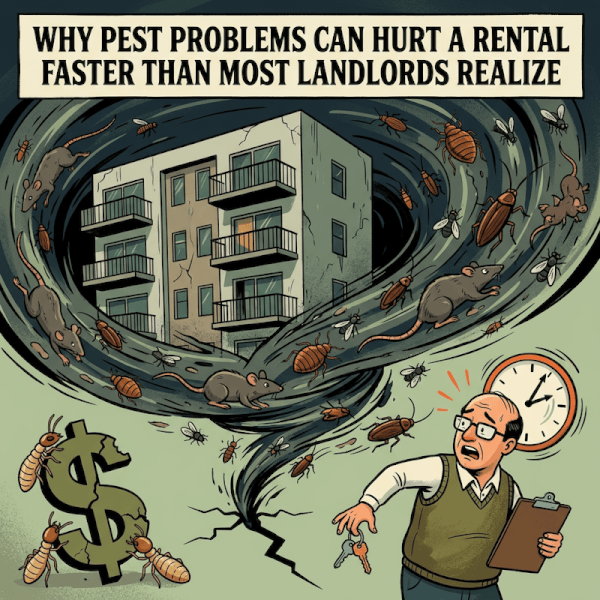
The mere sight of a pest can cause a renter to immediately change their perception of a home, including how they perceive the landlord. Whether it is a single mouse in the kitchen, a line of ants along a baseboard, or a wasp nest in the front of the home, the concerns that a pest causes a renter to have can be resolved in the span of a few days. They can quickly go from being concerned about a pest problem to being concerned about their lease and their relationship with their landlord. Today, let’s talk about why pest problems can hurt a rental faster than most landlords realize.
TLDR: Pest Problems Can Hurt A Rental
Pest problems in rental properties can become expensive and disruptive much faster than many landlords expect. Infestations don’t just create inconvenience; they can damage the property, affect tenant health and satisfaction, increase vacancies, harm online reviews, and potentially create legal issues. Preventive pest control and routine inspections help property owners protect their investment and maintain long-term profitability.
Pest problems affect many things for rental property owners: tenant satisfaction, lease renewals, and the condition of the rental property itself.
Related Links: Pest Problems Can Hurt A Rental
- Who Is Responsible for Pest Control, Landlords or Tenants?
- Pest Control For Apartment Buildings In Kansas City
- How to Rid Your Apartment of Roaches
- How to Avoid Bed Bugs When You Travel
- How Pests Affect Commercial Properties Beyond Residential Spaces
Small Problems Grow Quickly
A small problem can quickly become a large one. A couple of ants in the spring can develop into a full colony by summer. A single rodent finding access to a rental property through a hole in the foundation can develop into a full infestation before the property owner ever finds out about the problem. Early detection and consistent prevention are far more effective than waiting for a problem to develop before treating it. The EPA’s guidance on integrated pest management lists principles for effective IPM.
The issues in warmer climates are particularly worse because many of the pests are active year-round and, as a result, can cause problems in a rental property for extended periods of time. For example, many cockroach species can be active for months at a time, so even if a property is vacant for several months, cockroaches can re-infest the property prior to a new tenant moving in. Additionally, mosquitoes, fleas, and termites are also pests that are active for extended periods of time and can cause problems in a rental property for months at a time.

Tenant Retention Depends on How You Respond
For small problems, a late response can turn into a big problem. Tenants judge a landlord by how he or she handles pest problems. A delayed or dismissive response to a tenant’s report of a pest problem is one of the most common reasons for non-renewal of a lease. Most tenants will not wait to see if the problem goes away. Instead, they will begin looking for another rental home as soon as they feel that their landlord is not going to treat their reported problem seriously.
However, a landlord who can respond to issues promptly, who has a plan in place to deal with pest problems, and who can work with a professional pest control service to treat any issues that do come up will be better able to deal with any pest problems than a landlord who does not have a plan in place. This is especially true for a landlord who incorporates pest prevention into his or her regular property maintenance.
Key Takeaways: Pest Problems Can Hurt A Rental
- • Pest infestations can lead to costly repairs and structural damage.
- • Unresolved pest problems often result in unhappy tenants and higher turnover.
- • Negative reviews and vacancies can reduce rental income.
- • Certain pests pose health and safety risks to occupants.
- • Landlords are generally responsible for maintaining habitable living conditions.
- • Proactive pest management is usually less expensive than dealing with a major infestation.
- • Regular inspections help catch problems early.
- • Professional pest control services help preserve property value and tenant satisfaction.
Another important point that should be made about treating pests proactively is that it can make your communication with a tenant regarding finding a pest so much easier. Think about it. If you have a quarterly inspection plan in place for a property and there are any sort of problems at a rental property, a landlord should be able to contact a pest control company in a matter of hours and have the problem taken care of ASAP.
Property management companies who handle pest problems for rental property owners in this sort of way – such as WeLease Property Management – incorporate pest control into the standard routine of maintenance for properties. There are many different benefits to a strategy like this, and one of the main benefits is that it ensures that all maintenance at a rental property is being done in a proactive manner as opposed to on an emergency basis.
Of course, when pest control for a rental property is done on an emergency basis, the problems have already gotten out of control and will require much more work in the long run to address the issues. As with all maintenance, taking care of problems proactively yields much more with less work.
Outdoor Upkeep Is Part of Pest Prevention
One cannot maintain a property with overgrown grass, old lawn cuttings, and cluttered outside storage and have to ask why rodents, mosquitoes, and other pests have taken over a property. These insects breed and give birth to young in the tall grass, debris piles, and standing water created by poor yard maintenance.
Reducing mosquito populations around homes and other structures is very important, and one of the best methods for eliminating them is to eliminate standing water from the property. Standing water can be found in even the smallest of places, such as in the cap of a beer bottle or in the bloom of a potted plant.
Sealing gaps and cracks around the exterior of your rental property, including holes around pipes and the eaves of the roof, will also help to keep pests out. Seal up cracks in the foundation and walls and replace torn or deteriorating door sweeps. Keep in mind that by excluding pests from your property, you are also providing long-term protection to the structure itself.
Sealing Entry Points Protects the Property Long-Term
Pests can easily enter homes through the smallest of cracks and crevices. Gaps around pipes, cracks in foundations, deteriorating door sweeps, and worn window frames are just a few examples of how pests can find their way into homes and cause problems for property owners and renters alike.
Conducting a routine inspection to seal off entry points to pests is perhaps one of the best investments that a landlord can make in a property. The University of California’s Statewide IPM Program has put together a number of practical articles that outline exclusion techniques for a variety of residential pests.
Prevention Is Easier Than Recovery
Recovering from pest problems can be far more time-consuming and expensive than you might think. In addition to the costs associated with pest control services and any subsequent damage to your property, for example, the problems caused by rodents or termites in your rental can cause you to lose rent while the problems are being treated. The worst problem of all is that many potential renters will view a property with a history of pest problems as being problematic and try to avoid them at all costs.
FAQ: Pest Problems Can Hurt A Rental
Q: Why are pest problems such a big issue for rental properties?
A: Pests can damage the property, create health concerns, frustrate tenants, and increase vacancies, all of which affect profitability.
Q: Can pest infestations lower property value?
A: Yes. Rodents, termites, cockroaches, and other pests can cause damage and make a property less appealing to renters and future buyers.
Q: Are landlords responsible for pest control?
A: In many cases, landlords are responsible for maintaining a habitable property and addressing infestations, unless the problem was directly caused by a tenant.
Q: What happens if pest complaints are ignored?
A: Small infestations can spread quickly, leading to larger repair costs, unhappy tenants, lease terminations, and damage to the property’s reputation.
Q: How can landlords prevent pest infestations?
A: Regular inspections, sealing entry points, eliminating moisture issues, and scheduling professional treatments are among the most effective preventive measures.
Preventing a pest problem is easier than fixing a pest problem. Simple practices like keeping up with routine pest control treatments, outdoor maintenance, sealing up potential entry points, and responding quickly to tenant concerns can help to prevent a host of problems. All it takes is for a property owner to form a few good habits. Schedule your appointment to get started with a prevention plan for your rental properties.
Be Sure To Check Out Some Of Our Services:
Termites — Rodents — Ants — Bed Bugs